01Eyewitness account
Martha Dodd · 1939
Through Embassy Eyes
“pale blue”
Dodd met Hitler personally. Her account describes his eyes as appearing pale blue. The linked German radio article reproduces the passage from her memoir.
Open sourceHISTORY / SOURCE CHECK
Yes—blue or blue-gray is the best-supported answer.
Contemporary descriptions point to light eyes. The exact shade varies between blue and gray; the sources reviewed here do not establish brown eyes.
Read the sources01 / THE ANSWER
An eyewitness described pale blue eyes. A wartime report said gray. A later biography said blue or blue-gray. These sources favor light eyes, while leaving room for disagreement about the precise shade.
02 / SOURCES
Three sources, three different kinds of evidence. Open each one and check the wording yourself.
Through Embassy Eyes
“pale blue”
Dodd met Hitler personally. Her account describes his eyes as appearing pale blue. The linked German radio article reproduces the passage from her memoir.
Open sourceAnalysis of the Personality of Adolph Hitler · p. 60 / PDF p. 69
“neutral grey”
The OSS report calls his eyes grey. This is a compilation of information, not a clinical examination. Its footnote explicitly acknowledges differing descriptions.
Open sourceA Concise Biography of Adolf Hitler · p. 2 / PDF p. 5
“blue, or blue-gray”
Fuchs identifies the color as blue or blue-gray. This later secondary source is useful corroboration; it is not a separate eyewitness observation. The scan is hosted at UC Santa Barbara.
Open source03 / THE VISUAL RECORD
A real historical painting is evidence of how Hitler was represented. It is not a calibrated record of his iris color.
The eyes appear blue in this reproduction, but that does not establish their real-life color. This portrait is associated with the Imperial War Museums collection, catalogue ART LD 6217. It belongs to the official visual culture of the Nazi regime. That context matters when evaluating likeness and color.
We have not verified a document in which Hitler personally approves this painting’s eye color. Even documented approval would show acceptance of the image, not prove that every detail was realistic. Artists, lighting, pigments and reproduction can all affect the result.
Museum catalogue ↗The German Historical Museum records a separate Knirr portrait as a gift from A. Hitler dated 12 January 1937. This links him to an object, but does not document approval of its eye color. The record reports that the work was destroyed after the war.
DHM record RMG00882 ↗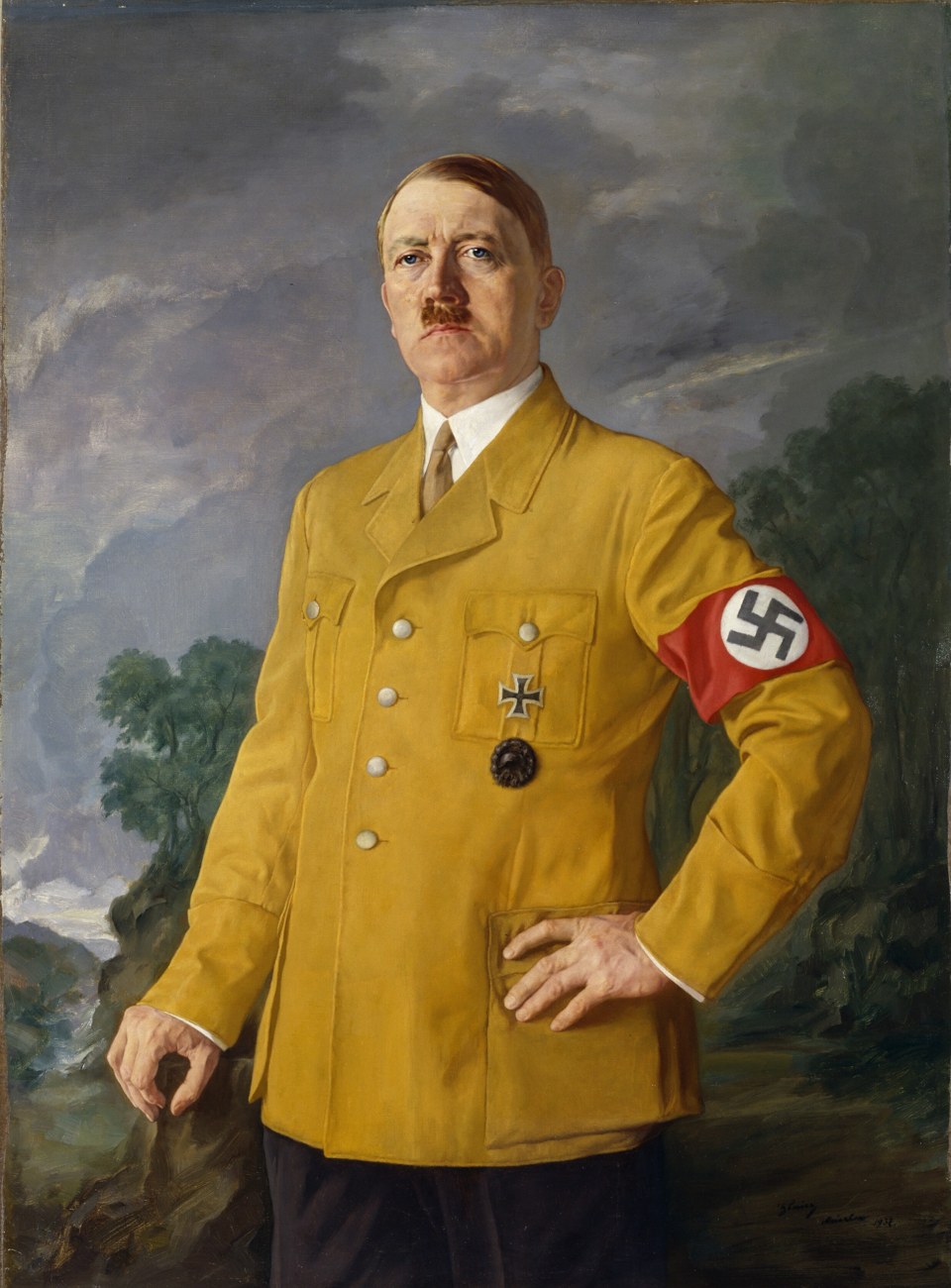
SOURCE CRITICISM
Personal observation carries more weight than an unattributed online claim. We retain conflicting descriptions, distinguish contemporary compilations from later biographies, and do not count repeated claims as independent evidence. This is a focused source review, not a survey of every surviving record.
04 / FAQ
The sources reviewed here do not provide strong support for brown eyes. They describe blue, blue-gray or gray. This does not prove that no contrary description exists anywhere.
A black-and-white image cannot directly record hue. A colorized image adds an interpretation; a painting also interprets its subject. Neither alone settles the question.
No. An individual’s appearance provides no basis for racial superiority. This page examines a historical detail and does not endorse Hitler or Nazi ideology.
No. Different descriptions alone do not establish manipulation. A specific claim of alteration needs evidence about the particular image or document.